We have seen this happen so many times with our students. They go into the exam hall with confidence because they have studied for weeks. But when they open the paper, they see a question they can easily recognise, and they start writing straight away. Everything feels fine. Then they reach part (b). It says “Hence…” And suddenly they are stuck. Their mind goes blank. They read it again, still nothing. They move on, frustrated, and lose marks.
And the worst part? It is not because they don’t know the maths. It is because they started solving before they understood how the question was structured.
So what if you gave every IB question three passes instead of rushing into it immediately?
The Three-Pass Method for IB Questions
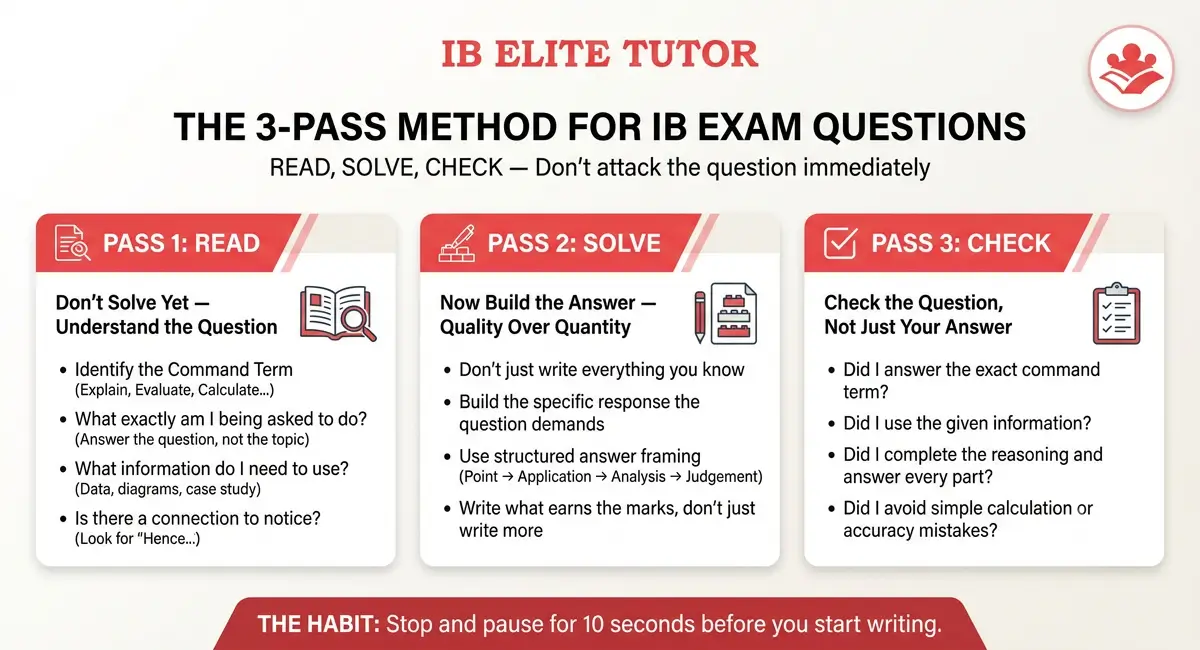
Every question gets three passes. The first pass is about reading and understanding. The second pass is about solving and building the answer. The third pass is about checking that you actually answered the question.
These are not three separate attempts at the same question. They are three different ways of looking at it. That distinction matters because it means you are not doing extra work—you are doing the same work with more awareness.
Pass 1 — Read IB Questions: Don’t Solve Yet
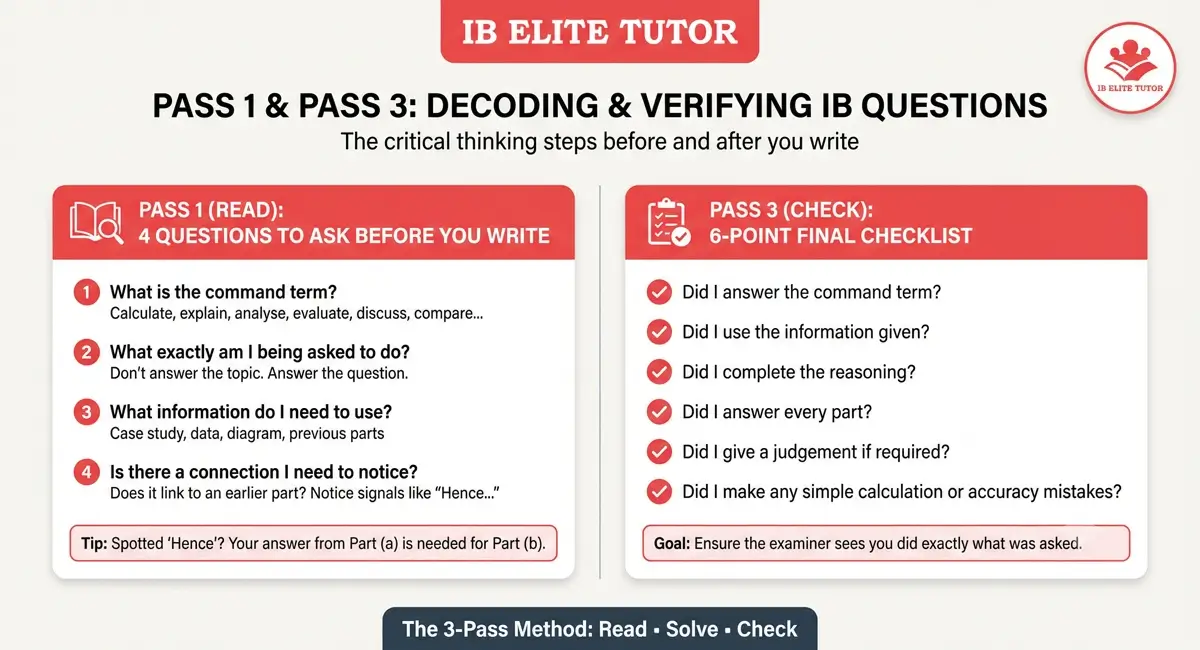
Your job here is to figure out the question before you write anything. You are not solving yet. You are working out what the question wants from you. Ask yourself four simple questions:
| What is the command term? | Is it asking you to calculate, explain, analyse, discuss, evaluate, or compare? Each of these demands something different from you. |
| What exactly am I being asked to do? | Don’t answer the topic. Answer the question. |
| What information do I need to use? | Has the question given you a case study, some data, a diagram, or information from an earlier part? |
| Is there a connection I need to notice? | Does this part link to something that came before it? |
Take a Maths AA HL question where Part (a) produces a result, and Part (b) begins with the word “Hence…” When you see that word, you should immediately think: my answer from Part (a) is probably important here. That is what “hence” means—it means use what you just found. If you spot that in Pass 1, you will not get stuck halfway through Pass 2 wondering what to do.
Pass 2 — Solve IB Questions: Now Build the Answer
Now you actually answer the question.
But here is the key message: don’t just put down everything you know about the topic. Build the answer the question requires.
This is where it’s easy to confuse knowledge with answer framing. You might think that because you know a lot about the topic, you should write a lot about it. That is not the same as answering the question.
Take a Business Management question: “Evaluate whether the business should adopt Strategy X.”
You might know the advantages, the disadvantages, the relevant business concepts, and all the case information. But knowing those things is not enough. You need to use them to answer the evaluation question. Your answer needs to follow a structure: point, application, explanation or analysis, and judgement.
A common student reaction at this point is: “If I need to answer better, I should write more.”
No. The goal is to write what gives you the marks, not everything you know. The difference is between writing everything you remember and using only the knowledge that helps answer the question. It keeps you focused and stops you from burying your best points under unnecessary information.
Pass 3 — Check IB Questions: Check the Question, Not Just Your Answer
Most students check their answers by asking: “Did I make a calculation mistake?” But Pass 3 is broader than that.
Ask yourself: Did I actually answer what was asked?
Here is a quick checklist:
| Did I answer the command term? |
| Did I use the information given? |
| Did I complete the reasoning? |
| Did I answer every part? |
| Did I give a judgement if one was required? |
| Did I make a simple calculation or accuracy mistake? |
This is a quick final scan, not another long process. You are not re-doing the question. You are making sure you gave the question what it asked for.
The Three Passes in Action: An IB Biology Example
Imagine a data-based question showing a graph of enzyme activity across different temperatures, followed by the prompt: “Explain the trend shown between 40°C and 60°C.”
| In Pass 1, | you spot the command term explain—give reasons, not just describe what the line does—and you note the specific range, 40°C to 60°C. |
| In Pass 2, | instead of writing everything you know about enzymes, you link the drop on the graph directly to high kinetic energy breaking hydrogen bonds and denaturing the active site. |
| In Pass 3, | make sure you mentioned the specific temperature range from the graph and explained why the rate fell, rather than just stating that it decreased. |
Does Every Question Need the Same Amount of Time?
No. The three passes do not have to take equal time.
| For a short calculation question, | Pass 1 might take a few seconds, Pass 2 is solving, and Pass 3 is a quick check. |
| For a long Business Management evaluation, | Pass 1 means spending more time understanding the command term and the case, Pass 2 is constructing the response, and Pass 3 is checking the judgement and application. |
The method stays the same, but the time you spend on each pass changes. That makes it realistic for an actual IB exam.
When You Are Stuck, Go Back to Pass 1
When you get stuck, your first instinct might be: “I don’t know this.”
But sometimes the problem is not that you don’t know the content. Sometimes the problem is that you haven’t understood the question.
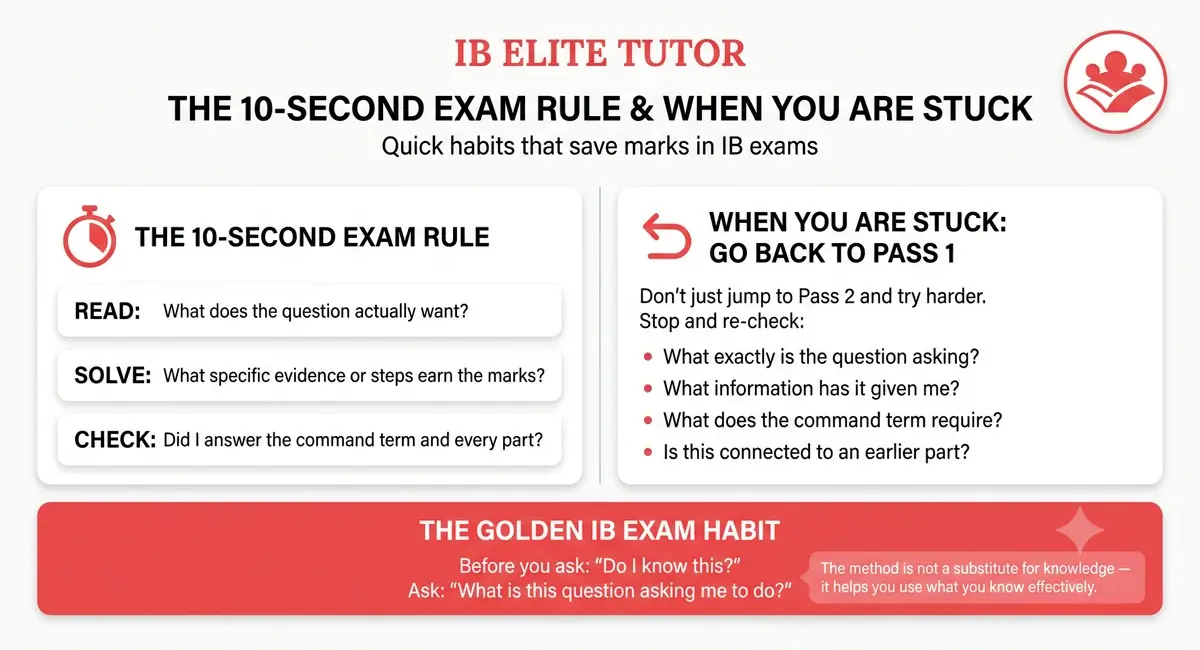
So if you are stuck, don’t always jump straight to Pass 2 and try harder. Go back to Pass 1. Ask yourself: what exactly is it asking? What information has it given me? What does the command term require? Is this connected to something earlier in the question?
Often the thing you are missing is not knowledge—it is a connection you didn’t notice in Pass 1.
This Method Is Not a Substitute for Knowledge
The method will not teach you calculus. It will not teach you Business Management. It will not replace revision.
Its job is different. It helps you use what you know more effectively when you are facing the actual question. That is all it promises, and that is enough.
The 10-Second Exam Rule
| Read: | What does the question actually want? |
| Solve: | What specific evidence or steps earn the marks? |
| Check: | Did I answer the command term and every part? |
Take This Into the Exam Hall
You don’t need another complicated exam technique. You need a simple habit: don’t rush into the question immediately. Read it. Solve it. Check it.
Before you ask, “Do I know this?” ask, “What is this question asking me to do?”
It starts with one small pause before you write.
Reading about a method is easy. Applying it while the clock is running is different. That gap is where students lose most of their marks, and it is exactly where a second pair of eyes helps. Our tutors at IB Elite Tutor have worked with IB students across Maths AA HL, Business Management, Biology, Economics, Chemistry and the sciences for years. They have watched the same stuck moments clear again and again — usually because of something small, like a command term a student has been misreading for two years or a part (b) that quietly depends on part (a).
So if a particular question or past paper keeps catching you out, please tell us about it. Write the subject, the question, and the part where the marks keep disappearing — a vague message earns you a vague answer. One of our tutors will read it properly and come back with something genuinely useful. Fill in the form below, and we will take it from there.

About the Author
The IB Elite Tutor Team
This article was written by the IB Elite Tutor team — a group of practising international-school teachers who work with the IB and Cambridge IGCSE curricula every day.
Because we understand the syllabus and assessment requirements students actually face, we share practical, honest guidance here to help families make confident decisions. Our approach is built on clear guidance, personalised support, and a genuine commitment to helping every student reach their potential.
Reviewed by our subject specialist team across Maths, Physics, Chemistry, Economics, and Business Management.
Learn more about IB Elite Tutor →