You’re sitting with an IB Mathematics AA HL Paper 2 in front of you. You come to a calculus question. You know the topic. You’ve done differentiation. You know how to find stationary points. Then Part (b) starts with “Hence…” and you get stuck. Later you look at the mark scheme.
Your method in (a) was correct. The issue was that you didn’t realise how to use the answer from (a) in (b). You knew the maths. You didn’t turn that knowledge into marks. This is one of the most frustrating parts of IB preparation: you can know the content and still lose marks because you did not give the question what it required.
In our Online IB tutoring sessions, I see this exact pattern every week: students often know the content but struggle to turn that knowledge into the marks the question asks for.
The Problem Is Not Always Your Knowledge
When students lose marks, the first reaction is often: “I need to study this topic again.” Sometimes that is true.
But sometimes the topic isn’t the problem at all. You may know the concept but:
- misunderstand what the question is asking
- miss the meaning of a command term
- fail to apply your knowledge to an unfamiliar situation
- stop your analysis too early
- answer without the required justification
- make a calculation or accuracy error
- run out of time
For example, in IB Business Management, you might know the relevant theory, discuss both sides of a strategy and use information from the case. But if the question asks for evaluation and your answer doesn’t reach a well-supported judgement, you can still lose marks.
The subject changes. The underlying problem is similar: There’s a gap between what you know, what the question is asking for, what you write, and what actually gets the mark. The IB Lost Marks Method identifies that gap.
Your grade tells you what happened. Your IB lost marks tell you what to fix.
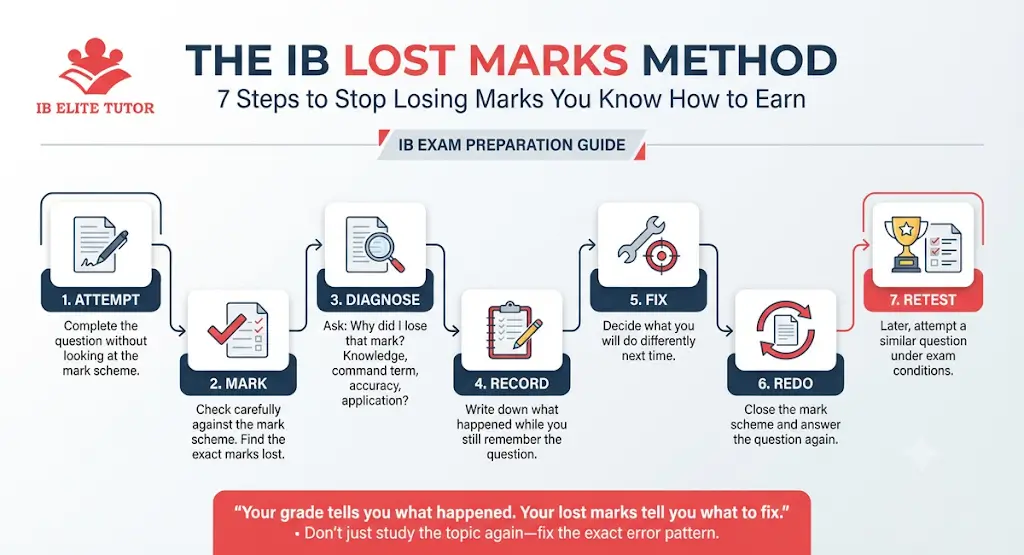
Rather than just recording your score after a test, start to record where your marks went. The process is simple.
| Step | What to Do |
| 1. Attempt | Complete the question without looking at the mark scheme. |
| 2. Mark | Check your answer very carefully against the mark scheme. Don’t just look at the final score. Find the exact marks you’ve lost. |
| 3. Diagnose | Ask: Why did I lose that mark? Was it knowledge, application, analysis, a command term, accuracy, or something else? |
| 4. Record | Write down what happened while you still remember the question. |
| 5. Fix | Decide what you’ll do differently next time. |
| 6. Redo | Close the mark scheme and answer the question again. |
| 7. Retest | Later, attempt a similar question. |
That last step matters. If you can spot the right answer when you’re looking at the mark scheme but can’t produce it yourself, then the issue hasn’t necessarily been resolved.
What Should You Record?
You don’t need to write an essay on every mistake. A useful lost-marks record can be as simple as:
| What Happened? | What Will I Do Next Time? |
|---|---|
| Maths AA HL — Calculus Question: In Part (b), I was asked to use the result from Part (a). Marks lost: 2 My mistake: I treated Part (b) as a new question and did not use my answer from Part (a). | When a question uses a word like “Hence”, I will check whether I am supposed to use the answer from the previous part. |
| Business Management — Strategy Question: I was asked to evaluate a proposed strategy. Marks lost: 2 My mistake: I discussed both sides of the strategy, but I did not give a clear, well-supported judgement. | When a question asks me to evaluate, I will make a clear judgement and support it using the case information. |
The purpose is not to create more homework. The purpose is to identify patterns. If you’re consistently losing marks for the same reason, that’s far more useful information than just knowing you scored 68%.
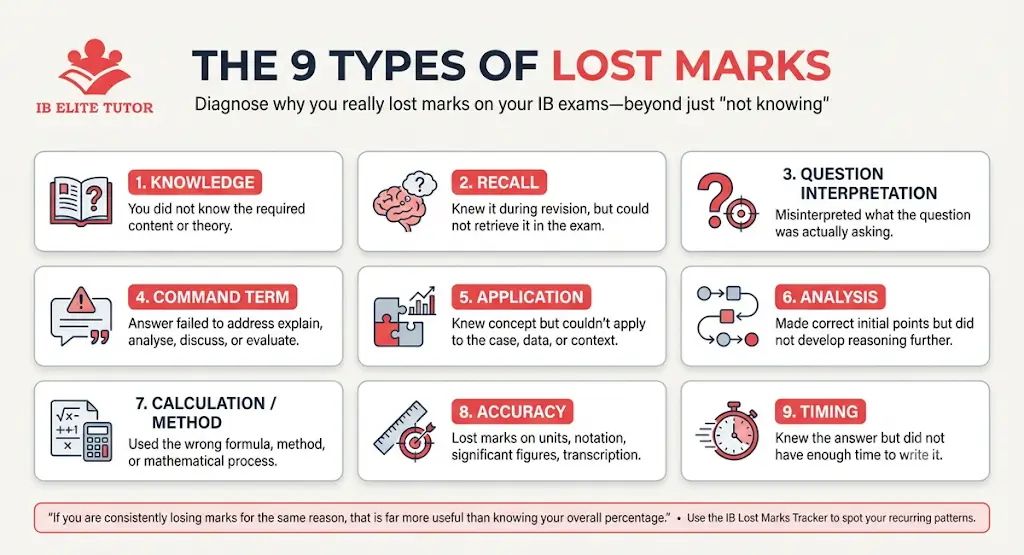
The Nine Types of IB Lost Marks
You don’t need to overthink the categorisation. Just pick the one that best describes what actually happened.
| IB Lost Mark Type | What Happened |
| Knowledge | You didn’t know the required content. |
| Recall | You knew it during revision but couldn’t retrieve it in the exam. |
| Question Interpretation | You completely misinterpreted what the question was asking. |
| Command Term | Your answer didn’t fully address the terms explain, analyse, discuss, or evaluate. |
| Application | You knew the concept but couldn’t apply it to the case, the data, or a new context. |
| Analysis | You were absolutely right, but didn’t develop the reasoning any further. |
| Calculation / Method | You used the wrong method, formula, or process. |
| Accuracy | You IB lost marks through units, notation, significant figures, transcription, and so on. |
| Timing | You knew the answer but didn’t have enough time to get it in properly. |
The important bit is not the label. It’s about establishing the real reason the mark was lost.
When the Markscheme Surprises You
A mark scheme can occasionally reveal something you didn’t actually realise the question was asking you to do.
Do not just think: “Right, I know the answer now.” Ask three questions:
- What did the question ask for?
- What did I actually demonstrate?
- What was the difference between the two?
That ‘missing piece’ is often the most valuable thing you can learn from the question. In the maths example, the missing piece was spotting the link between two parts of the question. In the Business Management example, it was turning the discussion into a supported evaluation. The answer itself matters less than understanding why your answer didn’t get the mark.
The Redo Rule
Here is the rule:
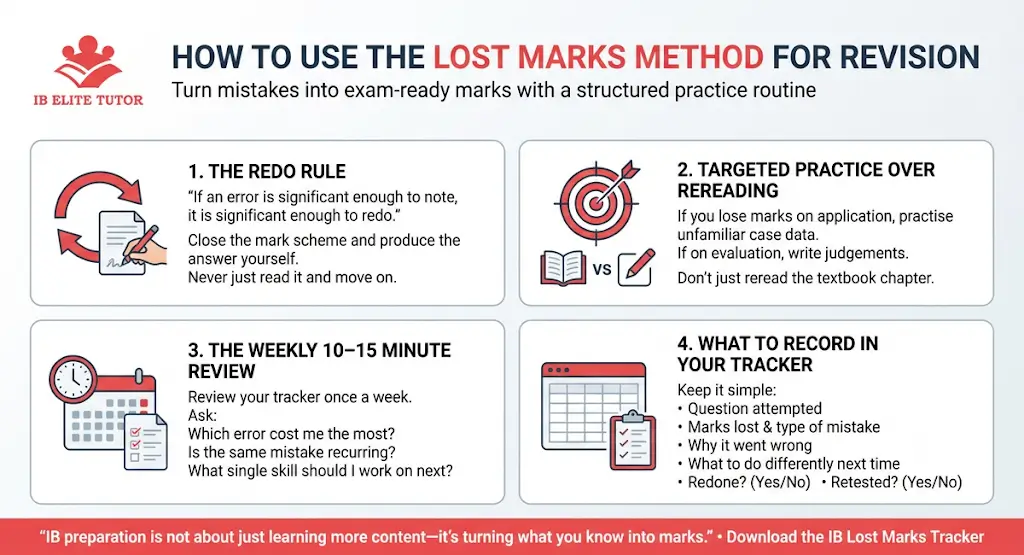
If an error is significant enough to note, it’s significant enough to redo.
After checking the mark scheme, put it away. Then answer the question again. Do not copy the mark scheme. Don’t just read your original answer and think “Right, I get it now”. Produce the answer yourself.
Then, when possible, try a similar question later. That’s how you go from recognising the right answer to actually producing it under exam conditions.
Let Your IB Lost Marks Decide What You Practise
IThis is where the method comes in useful for revision. Suppose your last few practice sessions have shown you’re consistently losing marks due to application. Reading the chapter again won’t fix the problem. You need more practice in applying the knowledge to questions you haven’t seen before. If it’s an evaluation, then do some evaluation. Whether it’s analysis, then work on your reasoning. If it’s about accuracy, then build a checking routine. Whether it’s about interpretation, then you need to spend more time working out precisely what the question is asking before you start writing. Your lost Which error cost me the most marks?
Is the same error cropping up over and over again?
Which topic or type of question is it actually being asked about?
What single skill should I be working on next?
Has the error improved since last week?
You’re not attempting to analyse your entire IB performance. You’re looking for one recurring weakness to fix next.
Use the IB Lost Marks Tracker
Having all of that in your head very quickly becomes a mess. That’s why we created a simple IB Lost Marks Tracker in Excel. You can record:
- the question you attempted
- the marks you lost
- the type of mistake
- what went wrong
- what you will do differently
- whether you have redone the question
- whether you could solve a similar question later
Over time, the tracker gives you something your overall grade cannot: a record of precisely where your marks are being lost.
[Download the IB Lost Marks Tracker]
The Goal Is Not Just to Know More
IB preparation is absolutely not just about learning more content. It’s all about getting better at taking what you know and turning it into the marks the question is asking for. So the next time you’re losing marks, don’t just write down your mark and be done with it. Find the IB lost marks. Find out why it was lost. Fix the problem. Redo the question. Then go and look for that same mistake again. Don’t just look at the marks you’ve got. Look at the marks you’ve lost and work out how you can get them back.
If you’re facing any problem with the IB Lost Marks Tracker or need help understanding how to use it, fill out the form below and contact us. We’ll be happy to help.

About the Author
The IB Elite Tutor Team
This article was written by the IB Elite Tutor team — a group of practising international-school teachers who work with the IB and Cambridge IGCSE curricula every day.
Because we understand the syllabus and assessment requirements students actually face, we share practical, honest guidance here to help families make confident decisions. Our approach is built on clear guidance, personalised support, and a genuine commitment to helping every student reach their potential.
Reviewed by our subject specialist team across Maths, Physics, Chemistry, Economics, and Business Management.
Learn more about IB Elite Tutor →